


Is Kenya’s Political Economy Ready for the Youth Schism?
- Kimani Patrick

- Feb 23
- 3 min read

On the surface, Kenya in early 2026 appears politically and economically steady. Yet that stability masks a deeper transition, driven less by party competition and more by a rising demand for accountability from a young electorate.
As the country moves toward the 2027 election, the central issue may not be who wins power. It may be whether Kenya’s institutions can absorb this shift without losing public trust in the process.
For decades, Kenya managed political tension through elite accommodation. Agreements at the top often cooled conflict on the ground, even when they left structural problems unresolved.
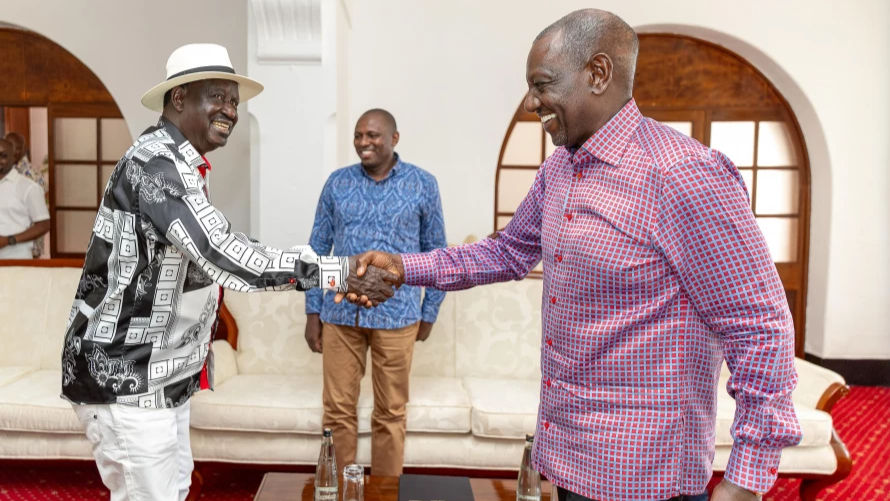
The handshake era reflected this logic. It preserved stability, but it also normalised the idea that political order could be negotiated rather than earned.
The current broad-based government appears to formalise that tradition. Bringing opposition figures into state structures was meant to ensure legislative cooperation, support fiscal discipline, and project unity to creditors and partners. On paper, it reduces political risk.
In practice, the effect has been mixed. Some citizens see stability. Others see the disappearance of meaningful opposition.
Instead of strengthening confidence, the arrangement has raised a quieter question: if everyone is inside government, who is left to hold it accountable?
The passing of Raila Odinga made this tension harder to manage. His presence had long anchored opposition politics and helped contain internal disputes. Without him, divisions inside ODM surfaced more openly.
One faction argues that collaboration with the government ensures policy influence and national cohesion. Another believes it weakens oversight and leaves citizens exposed. What once looked like a party rivalry now mirrors a wider national debate about what opposition should mean in Kenya today.
What is emerging from this environment is not simply youth activism. It is a shift in how leadership is judged. Increasingly, citizens are measuring power through performance, responsiveness, and visible outcomes rather than identity or historical alliances.
Several leaders illustrate this shift in different ways.
Ndindi Nyoro has built a profile around efficiency, education, and the practical use of public funds. His arguments about procurement inefficiencies and labour-driven development resonate because they speak to results, not rhetoric. Many young voters respond to leaders who speak in numbers rather than narratives.
Edwin Sifuna’s influence comes from his use of institutions themselves. He relies on legal processes, parliamentary platforms, and public accountability arguments to challenge authority. That approach appeals to citizens who want systems to function properly, not simply to see new personalities rotate through the office.
Babu Owino channels a more visceral energy. His message draws from lived experience, economic struggle, and education as a pathway out of marginalisation. He speaks to urban youth who judge leadership by whether it improves their daily lives. Together, these figures suggest that legitimacy in Kenya is slowly shifting from identity toward performance.
This transformation is rooted in demographics as much as politics.
Kenya is a very young country. A large share of voters grew up in a digital environment, exposed to global conversations about governance, opportunity, and fairness. Many do not carry the loyalties that shaped previous elections. Ethnicity still matters, but it is no longer sufficient on its own.
Young citizens facing unemployment, rising living costs, and uncertain futures tend to evaluate leadership through economic outcomes. Their expectations are shaped less by history and more by opportunity. When they speak about accountability, they are often speaking about survival.
The next election will test more than political alliances. It will test whether institutions can respond to pressure in ways that build confidence rather than erode it. If state institutions demonstrate openness, enforce rules consistently, and engage criticism seriously, Kenya could emerge from this period with stronger governance and a more resilient political settlement.
If the response leans toward defensiveness or symbolic reform without substance, the greater risk may be a gradual erosion of trust. That kind of erosion rarely produces dramatic headlines, but it quietly weakens the foundations on which stability depends.
Kenya has navigated difficult moments before without systemic collapse. That resilience remains one of its strengths. But resilience built on negotiated stability is now meeting a generation that expects accountability as a baseline rather than a concession.
The coming years will show whether Kenya can shift from stability maintained through elite agreements to stability earned through institutional credibility. The answer will shape not only the 2027 election but also the long-term confidence citizens, investors, and partners place in the country’s democratic model.


Comments