


Lunar Eclipse Explained: What Kenyans Saw in the Sky on Sunday Night
- Christabel Adhiambo

- Sep 8, 2025
- 3 min read
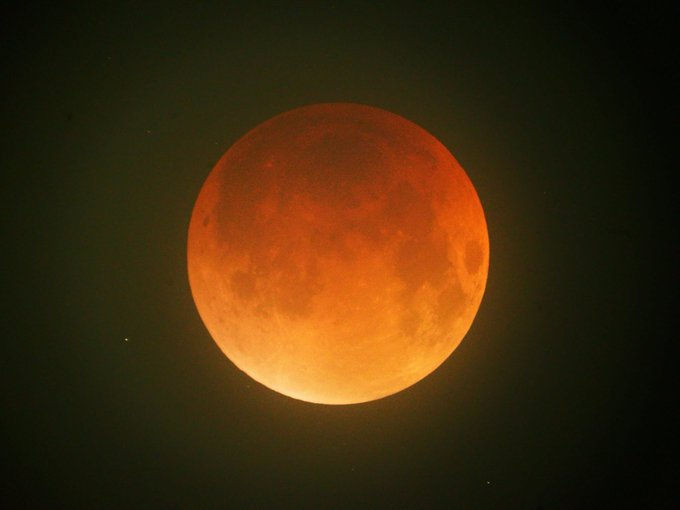
On the night of Sunday, September 7, Kenya witnessed a rare celestial spectacle a total lunar eclipse, also known as a Blood Moon.
The eclipse began at 8:31 PM East Africa Time (EAT), reaching its peak at 9:12 PM and lasted for several hours as the Moon passed through Earth’s shadow.
Residents across Nairobi, Mombasa, Kisumu and other towns stepped outside their homes to witness the lunar transformation. Social media buzzed with images and videos as Kenyans shared their excitement at seeing the Moon take on a reddish hue.
At Samburu Sopa Lodge, the event coincided with the launch of Kenya’s first dedicated astro-tourism initiative led by the Tourism and Wildlife Cabinet Secretary, Rebecca Miano.
She had joined Kenya Wildlife Service (KWS) Director General Prof. Erustus Kanga, Samburu Governor Jonathan Lati Leleliit, Kenya Space Agency Brig. Hillary Kipkosgey, and KTB Ag. CEO Allan Njoroge in celebrating the country’s potential as a stargazing destination.
"Tonight, we are not just witnessing a Blood Moon; we are witnessing the dawn of a new era for Kenya’s tourism. This celestial event reminds us that our skies, like our parks, have the power to inspire and shine on the global stage," Miano stated.
KWS emphasized that Kenya’s clear, unpolluted skies, especially in areas such as Samburu, offer unparalleled conditions for observing celestial events.
The initiative also included the opening of a planetarium at Samburu Sopa Lodge, giving visitors a new way to explore the stars and learn about astronomy.
Miano emphasized that the Blood Moon eclipse was more than just a spectacular night sky event, as it highlighted Kenya’s potential to attract astro-tourists and educate the public about astronomy.
“It also demonstrated how natural phenomena can create opportunities for science engagement, tourism, and community learning,” she added.
What Is a Lunar Eclipse?
A lunar eclipse occurs when the Earth passes directly between the Sun and the Moon, blocking sunlight and casting a shadow across the lunar surface.
Lunar eclipses are safe to observe with the naked eye, unlike solar eclipses, which require protective eyewear.
There are three main phases of a lunar eclipse:
Penumbral Eclipse: The Moon passes through the outer part of Earth’s shadow, causing a subtle dimming that is often hard to detect.
Partial Eclipse: Only a portion of the Moon enters Earth’s shadow, creating a visible dark segment on its surface.
Total Eclipse: The Moon is completely engulfed in Earth’s shadow, often taking on a dramatic red or copper color.
During a total lunar eclipse, the Moon’s full immersion in Earth’s shadow is what gives rise to the term “Blood Moon.”
The Science Behind the "Blood Moon"
The reddish color of a Blood Moon is caused by a phenomenon called Rayleigh scattering.
As sunlight passes through Earth’s atmosphere, shorter blue wavelengths are scattered in all directions, while longer red and orange wavelengths pass through and bend toward the Moon.
This filtered sunlight illuminates the Moon with a deep red hue. The exact shade of red can vary depending on atmospheric conditions such as dust, pollution, or volcanic ash.
Essentially, the color of a Blood Moon is a projection of every sunrise and sunset on Earth, cast across the lunar surface.
Each eclipse is therefore unique, with subtle differences in color and brightness depending on what is happening in our planet’s atmosphere at the time.
Did It Only Happen in Kenya?
Lunar eclipses are global events, visible wherever the Moon is above the horizon at the time of the eclipse.
The September 7, Blood Moon was observable in other parts of Africa, Europe and Asia, though the timing and visibility varied by location.
Kenya, however, provided especially clear and stunning views due to minimal light pollution in many regions, high elevations in areas like Samburu, and generally clear equatorial skies.


Wow